
Not Enough Jawbone for an Implant? Bone Grafting and Sinus Lift Explained
Replacing a missing tooth with a dental implant is one of the most reliable long-term solutions for restoring your smile and chewing function. However, during an initial consultation, some patients are informed that they do not have enough bone height or density to support the titanium post directly. Adequate jawbone structure is essential because implants rely on solid bone to anchor securely in place. When teeth have been missing for several months or years, natural bone resorption occurs, reducing the available support. Fortunately, procedures like a bone graft for dental implants and a sinus lift procedure make it possible to rebuild lost bone structure, ensuring you can still receive stable, natural-looking implants.
Why Is Adequate Jawbone Important for Dental Implants?
A dental implant functions as a new artificial metal tooth & root. For it to withstand daily chewing forces, it must be completely surrounded by healthy, solid bone.
When a tooth is lost or extracted, the surrounding jawbone loses the natural stimulation previously provided by the tooth root. Over time, the body begins to resorb or break down the unused bone tissue. This leads to a gradual decrease in bone volume across three key dimensions:
- Bone Height: The vertical distance available from the ridge of the jaw to underlying structures, such as nerves or the sinus cavity.
- Bone Width: The thickness of the jawbone ridge necessary to fully enclose the implant post.
- Bone Density: The internal hardness and quality of the bone, which affects how firmly the implant anchors.
Without sufficient jawbone volume, a dental implant cannot achieve proper stability. Through a biological process called osseointegration, natural bone cells grow around and fuse with the biocompatible titanium surface of the implant. If the bone volume is deficient, osseointegration may fail, risking implant mobility or failure. Therefore, evaluating bone volume prior to treatment is critical for long-term success.
What Happens If There Is Not Enough Bone for a Dental Implant?
Discovering that you don't have adequate bone for an implant placement does not mean you are ineligible for dental implants. It simply means your jaw requires preliminary or simultaneous structural support.
Jawbone deterioration occurs for several common clinical reasons:
- Prolonged Tooth Loss: Jawbone loss begins within months after losing a tooth.
- Advanced Periodontal Disease: Severe gum infections destroy the underlying bone supporting natural teeth.
- Trauma or Injury: Facial trauma can break or alter the structural jawbone.
- Anatomical Variations: Naturally thin bone ridges or low-descending maxillary sinus cavities in the upper jaw.
To evaluate your structural eligibility, an implantologist performs a comprehensive clinical assessment using 3D Cone Beam Computed Tomography (CBCT). This advanced diagnostic tool creates detailed 3D cross-sectional views of your jawbone, allowing the dental team to map precise bone measurements down to the millimeter.
Not every patient with bone loss requires extensive grafting; treatment planning is entirely individualised. If bone volume is slightly reduced, minor grafting can often be performed at the same time as implant placement. If bone loss is significant, a separate bone regeneration phase may be recommended first.
What Is a Bone Graft for Dental Implants?
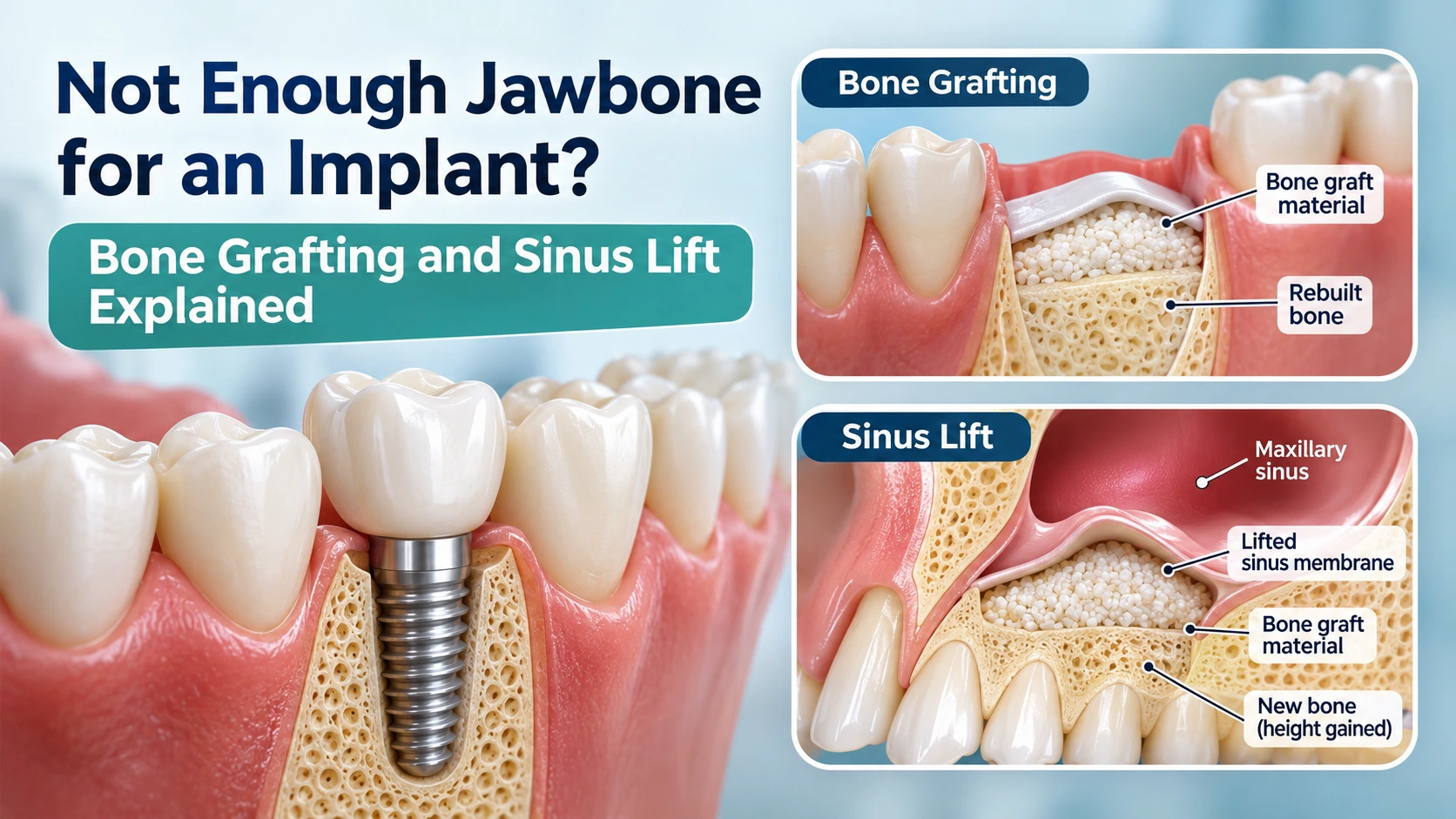
A bone graft for dental implants is a localized surgical procedure designed to repair or rebuild areas of the jawbone that lack sufficient volume or density.
During bone augmentation, specialized biocompatible material is placed into the deficient area of the jaw. The graft material acts as a temporary biological scaffold. Over time, your body’s natural regenerative processes use this scaffold to deposit new, natural bone cells into the area while gradually absorbing the graft material.
Depending on individual clinical requirements, different categories of graft materials may be utilized:
- Autogenous Grafts: Bone tissue taken from another area of the patient's own body (such as another part of the jaw).
- Allografts: Human donor bone tissue obtained from certified, sterile tissue banks.
- Xenografts: Biocompatible bone material sourced from animal origin (typically bovine), processed to be completely safe and sterile.
- Synthetic Grafts (Alloplasts): Biocompatible mineral compounds, such as calcium phosphate or hydroxyapatite, created in a laboratory setting.
The choice of graft material depends on your specific oral anatomy, the degree of bone loss, and your medical history.
How Is the Dental Bone Grafting Procedure Performed?
The surgical process for bone grafting follows a structured clinical approach:
- Diagnostic Evaluation: Comprehensive oral assessment and 3D CBCT scanning to evaluate precise bone loss dimensions.
- Treatment Planning: Selection of the appropriate graft material and determination of whether grafting can occur simultaneously with implant placement or requires a separate phase.
- Site Preparation: Local anesthesia is administered, and a small incision is made in the gum tissue to expose the underlying jawbone defect.
- Graft Placement: The selected graft material is precisely shaped and packed into the deficient area.
- Membrane Protection: A protective collagen membrane is often placed over the graft to keep the material secure and prevent faster-growing gum tissue from invading the bone space.
- Closure and Healing: The gum tissue is closed with small sutures. Over the following months, natural bone remodeling takes place.
- Reassessment: Once mature, solid bone has formed, the site is re-evaluated for final implant placement.
What Is a Sinus Lift Procedure?
A sinus lift procedure—also known as sinus augmentation—is a specialized form of bone grafting performed exclusively in the upper back jaw (posterior maxilla).
The maxillary sinuses are air-filled cavities located directly above your upper back teeth. When upper molars or premolars are lost, two things often happen simultaneously: the lower border of the upper jawbone ridge resorbs upward, and the sinus floor expands downward (a process called sinus pneumatization). This leaves a very thin layer of bone separating the mouth from the sinus cavity.
If an implant were placed into this thin bone without modification, it could extend directly into the maxillary sinus cavity, leading to instability or sinus complications.
During a sinus lift:
- A tiny access point is created in the upper jawbone.
- The delicate membrane lining the maxillary sinus cavity is gently lifted upward.
- Bone graft material is inserted into the space created beneath the lifted sinus membrane.
This effectively raises the sinus floor and adds vital bone height, creating a solid base for upper jaw dental implant procedures.
When Is a Sinus Lift Required Before Dental Implants?
A sinus lift is typically recommended when:
- The vertical height of the upper back jawbone is less than 4 to 6 millimeters.
- The maxillary sinus is naturally large or located close to the ridge.
- Multiple upper back teeth have been missing for a prolonged period.
CBCT imaging allows your dental specialist to measure the exact distance between the ridge of your gum and the floor of your sinus. Depending on how much bone height needs to be gained, your specialist may choose between a direct (lateral window) sinus lift for significant bone loss or an indirect (crestal) sinus lift for minor height additions.
Bone Grafting vs Sinus Lift – What Is the Difference?
While both procedures aim to rebuild bone volume for successful implant placement, they differ in location and execution.
Bone Grafting vs. Sinus Lift Comparison
| Feature | General Dental Bone Grafting | Sinus Lift Procedure |
|---|---|---|
| Primary Purpose | Rebuilds bone width, height, or density across any part of the jaw. | Specific augmentation to increase vertical bone height in the upper back jaw. |
| Treatment Area | Upper or lower jaw, front or back tooth regions. | Upper posterior jaw (molar and premolar area directly below the maxillary sinus). |
| Common Indication | Bone resorption following tooth loss, gum disease, or trauma. | Less bone height due to sinus expansion or upper molar loss. |
| Procedure Technique | Graft material is applied directly onto or into a jawbone defect under the gums. | The sinus membrane is carefully elevated upward, and graft material is placed beneath it. |
| Healing Duration | Varies individually based on graft size and patient health. | Requires structural integration of the new graft under the sinus floor before heavy loading. |
| Implant Timing | Can be simultaneous for minor defects, or staged for moderate-to-severe loss. | Can be simultaneous if sufficient baseline bone exists, or staged if bone height is very less. |
Jaw Bone Loss and Dental Implants in Jayanagar
If you are experiencing jaw bone loss, timely dental evaluation is essential available in Infinit dental Implant Clinic in Jayanagar. Leaving empty tooth spaces untreated over long periods allows bone resorption to continue, which can complicate future restorative options.
At Infinit Dental Solutions, located in Jayanagar, Bangalore, patients undergoing bone loss are evaluated, receive comprehensive diagnostic imaging and individualized care plans. Modern digital imaging and 3D CBCT scans ensure that bone depth, density, and sinus proximity are accurately mapped before any surgical recommendations are made.
Whether you require single-tooth replacement, full-arch restoration, or preliminary bone augmentation, consultation with an experienced oral healthcare team ensures safety, accuracy, and optimal long-term outcomes.
Consult Implant Specialists at Infinit Dental Solutions
Proper diagnostic assessment and execution by experienced dental professionals are critical when treating complex bone loss.
At Infinit Dental Solutions, patient evaluations and implant procedures are led by senior specialists:
-
Dr. Shambhu H S
BDS, MDS – Maxillofacial Prosthodontist, Implantologist, and Cosmetic Dentist
-
Dr. Arati Talikoti
BDS, MDS, Fellow ICOI (USA) – Maxillofacial Prosthodontist, Implantologist, Cosmetic Dentist, and Laser Specialist
Located conveniently in Jayanagar 9th Block, Bangalore, the clinic is easily accessible to patients residing in nearby neighborhoods, including JP Nagar, Banashankari, BTM Layout, and surrounding areas.
If you have been told you have thin jawbone volume or are interested in restoring missing teeth with long-lasting restorative dental treatments, contact our dental clinic to discuss your personalized treatment options.