Single Dental Implant vs Dental Bridge: Which Is Better for One Missing Tooth?
A missing tooth is more than a gap in your smile. Over time, neighbouring teeth can drift, the opposing tooth can move out of position, chewing becomes uneven, and the jawbone under the gap can slowly shrink.
When people compare dental implant vs bridge , they are choosing between two well-established tooth replacement options. A dental implant replaces the root and the crown. A bridge replaces the visible tooth by using the teeth beside the gap as support. Neither is best for everyone. The right choice depends on your jawbone health, neighbouring teeth, oral hygiene, budget and overall dental needs.
What Is a Single Dental Implant?
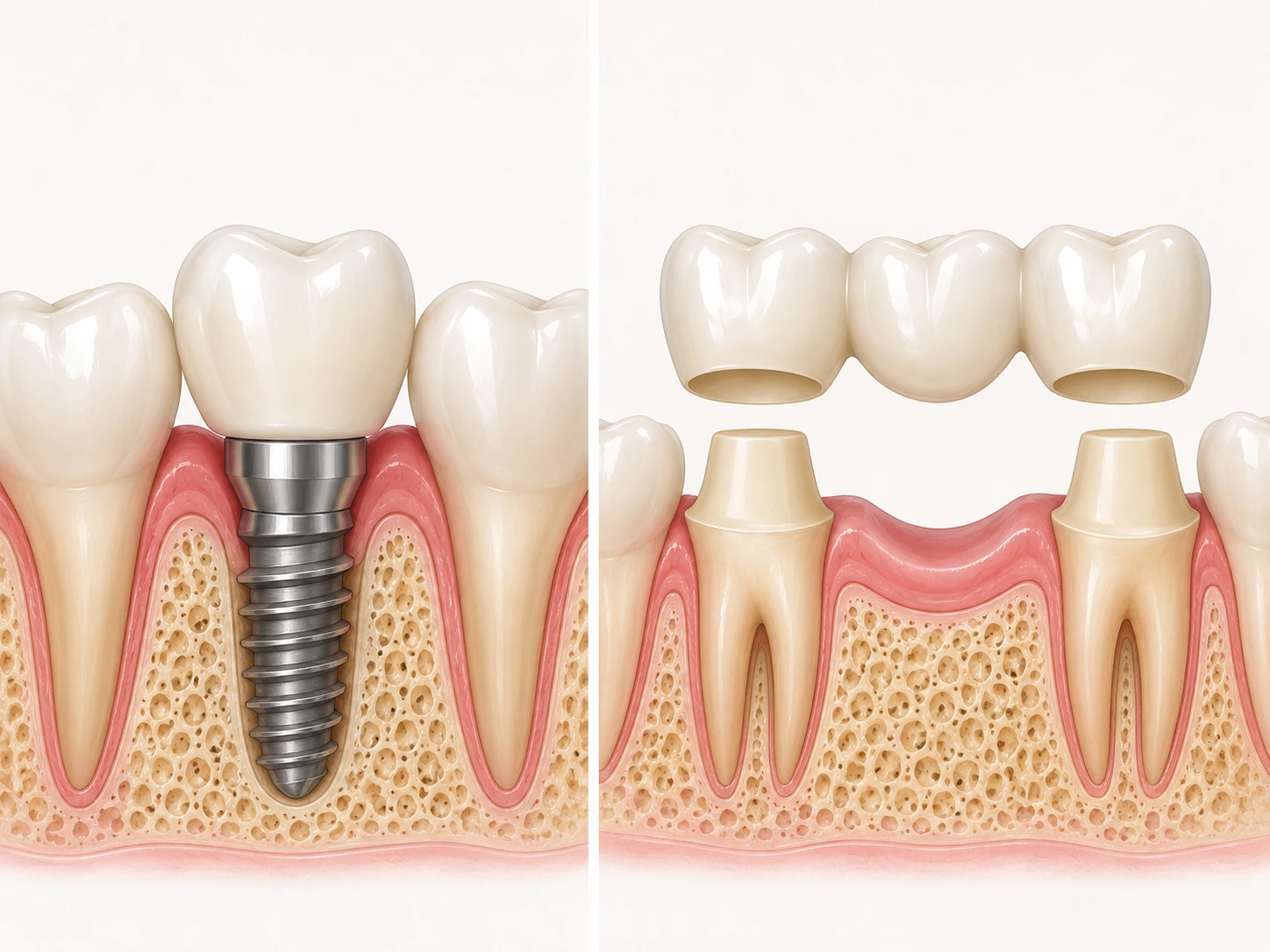
A single tooth dental implant has three parts: a small titanium post placed in the jawbone, a connector (abutment), and a crown on top. The post acts as an artificial tooth root, and the implant-supported crown restores the part you see and chew with.
The dental implant procedure usually follows these stages:
- Examination, X-rays or a 3D scan, and treatment planning
- Placement of the implant in the jawbone
- A healing period for osseointegration, where the bone gradually bonds with the implant
- Fitting of the abutment and the final crown
Healing time varies from person to person, and it is usually a matter of months rather than weeks. People with healthy gums, adequate bone and good oral hygiene are often suitable candidates. Your dentist will confirm this after an examination of your dental implants options.
What Is a Dental Bridge?
A traditional dental bridge replaces a missing tooth with an artificial tooth (pontic) joined to crowns on the teeth on either side of the gap. Those neighbouring teeth, called abutment teeth, carry the load of the bridge.
The dental bridge treatment is usually completed in a few visits. The supporting teeth are shaped, an impression or scan is taken, and a custom bridge is made and cemented in place. A bridge may be considered when the neighbouring teeth already need crowns, when implant surgery is not suitable, or when a quicker non-surgical solution is preferred. You can read more about dental crowns and bridges on our service page.
Dental Implant vs Bridge – Key Differences
The main differences are in how each treatment is supported, what it means for neighbouring teeth, and what happens to the bone. The comparison table below sets them out side by side.
Dental Implant vs Bridge Comparison Table
| Factor | Single Dental Implant | Traditional Dental Bridge |
|---|---|---|
| Treatment procedure | Titanium post placed in the jawbone, then an abutment and crown fitted | Neighbouring teeth are prepared and a bridge is cemented over them |
| Impact on neighbouring teeth | Usually does not require preparing adjacent healthy teeth | Adjacent teeth are usually reshaped to support the bridge |
| Jawbone preservation | Replaces the root and helps stimulate the bone | Does not replace the root, so bone under the gap may gradually reduce |
| Treatment duration | Longer, as healing and osseointegration take time | Generally shorter, often a few visits |
| Durability and maintenance | Can last many years with good hygiene and regular reviews; the crown may need attention over time | Can last many years with careful cleaning; may need repair or replacement eventually |
| Appearance and functionality | Natural-looking, stands independently and feels close to a natural tooth | Natural-looking and functional, supported by adjacent teeth |
| Surgical requirements | Minor surgical procedure needed; bone grafting in some cases | Usually no surgery |
| Long-term considerations | Depends on bone health, gum health and hygiene | Depends on the health of the supporting teeth and the cleaning routine |
Keep in mind that this is a general comparison. Your own mouth may favour one option over the other.
Dental Implant Pros and Cons
Advantages
- It does not normally require cutting down neighbouring healthy teeth.
- It stands independently, so adjacent teeth are not used for support.
- It transmits chewing forces to the jawbone, which helps maintain bone stimulation.
- No sensitivity or decay as it is a metal tooth.
Limitations
- It needs enough healthy bone, and some patients need bone grafting or other additional procedures.
- It involves a minor surgical procedure and a healing period.
- It needs diligent oral hygiene and regular dental reviews to stay healthy.
Dental Bridge Pros and Cons
Understanding bridge pros and cons helps you weigh it fairly against an implant.
Advantages
- It usually does not need implant surgery.
- It can offer a relatively quicker tooth replacement.
- It can be a practical choice when the adjacent teeth already have large fillings or crowns.
Limitations
- It relies on neighbouring teeth, which may need reshaping even if they are healthy.
- It does not replace the missing tooth root, so the bone under the gap may continue to reduce.
- Cleaning under the bridge needs extra care, using floss threaders or interdental brushes.
- It may need maintenance or replacement over time.
Implant or Bridge for One Tooth – Which Should You Choose?
Choosing an implant or bridge for one tooth is a decision best made after a proper examination. Your dentist will usually consider:
- Adjacent teeth: Are they healthy and untouched, or already heavily restored?
- Jawbone and gums: Is there enough bone density, and are the gums free from active disease?
- Medical and dental history: Conditions like uncontrolled diabetes, smoking habits and gum disease can affect healing.
- Your preferences: Some people prefer to avoid surgery, while others prefer to avoid touching nearby teeth.
- Time: Do you need a faster solution, or can you wait through the healing period?
- Budget and long-term care: Consider both the initial cost and the maintenance over the years.
A dental implant may be considered when neighbouring teeth are healthy and bone support is adequate. A bridge may be a reasonable alternative when the adjacent teeth need crowns anyway, or when surgery is not advisable. No single answer fits everyone, and your dentist must evaluate you before recommending a treatment.
Single Tooth Replacement in JP Nagar – What Should Patients Consider?
If you are searching for a single tooth replacement in JP Nagar, look beyond the treatment name. Check the qualifications and experience of the dental team, ask for all suitable options to be explained, understand the steps and timeline, and make sure follow-up visits are part of the plan.
Many people also search for dental implants in JP Nagar or dental implants near me because implant care involves several visits. A clinic that is easy to reach makes it simpler to keep those appointments. Infinit Dental Solutions is located in Jayanagar, Bangalore, and is accessible for patients from JP Nagar and other parts of South Bangalore. We do not have a separate JP Nagar branch.
Consult a Dental Specialist at Infinit Dental Solutions
At Infinit Dental Solutions, our dental specialists include:
- Dr. Shambhu H S – BDS, MDS, Maxillofacial Prosthodontist, Implantologist and Cosmetic Dentist
- Dr. Arati Talikoti – BDS, MDS, Fellow ICOI (USA), Maxillofacial Prosthodontist and Implantologist
A personalised examination, X-rays and a clear discussion of options come first, so that the choice between an implant and a bridge is based on your needs rather than a standard plan. If you would like to discuss your missing tooth, you can book a dental consultation at our Jayanagar clinic.
Call To Action :
Not sure whether a dental implant or a bridge suits your missing tooth?
Visit Infinit Dental Solutions in Jayanagar, Bangalore, for a personalised examination and a clear discussion of your options with our specialists. Contact our dental clinic to schedule your appointment.