
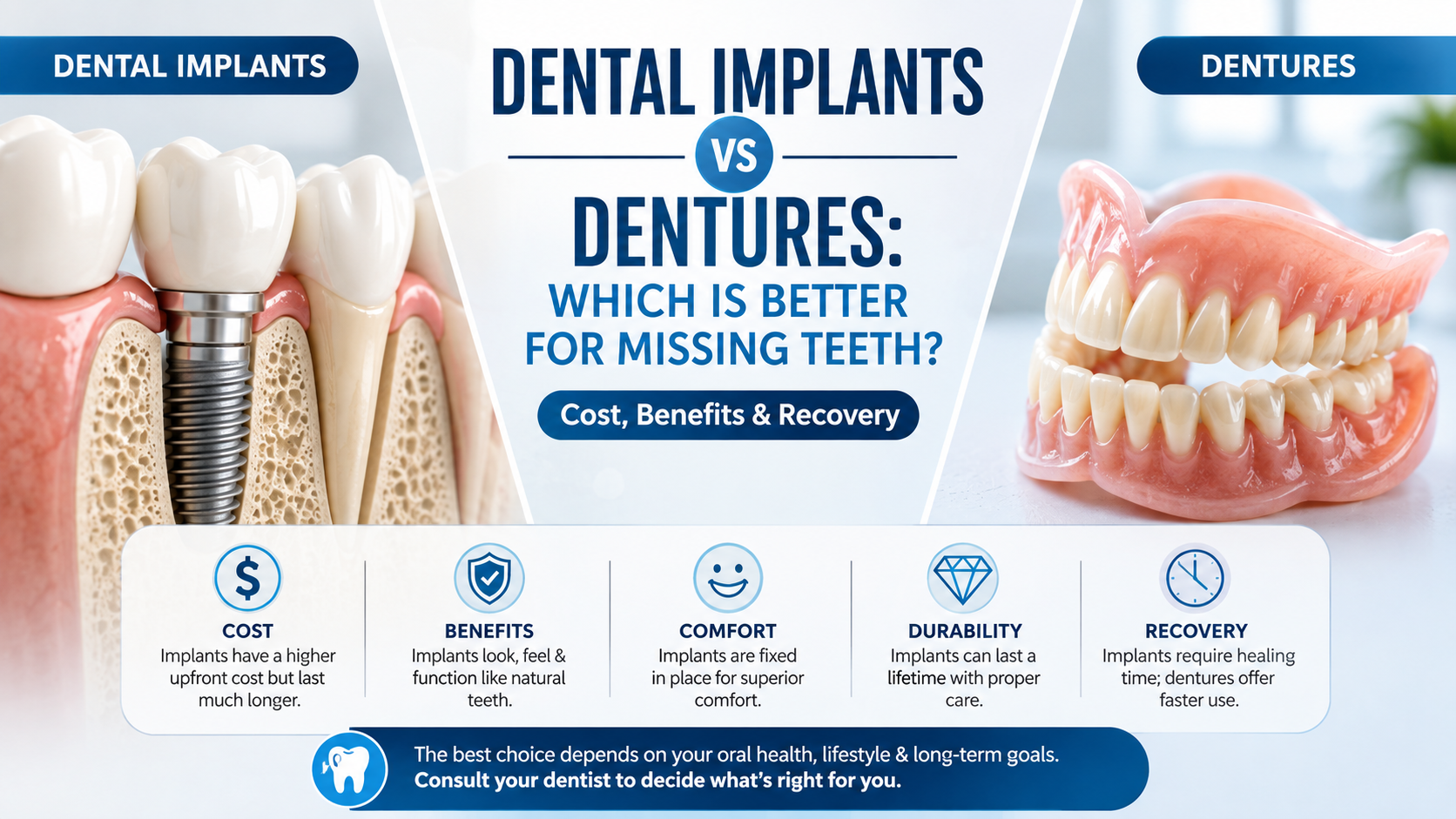
Dental Implants vs Dentures: Which Is Better for Missing Teeth? Cost, Benefits & Recovery
Losing a tooth rarely feels urgent at first. A gap at the back of the mouth might not even show when you smile, so it's tempting to leave it alone. But missing teeth tend to affect more than appearance over time — chewing becomes uneven, nearby teeth can shift, and speech sometimes changes in ways patients don't expect. This is usually the point Where people look for different replacement options comparing between implants and dentures, two of the most common tooth-replacement options available today.
Both approaches can restore a functional smile, but they work very differently, and neither is automatically the "right" choice for every patient. Bone health, the number of missing teeth, gum condition, budget and personal comfort with surgery all Play a crucial role. If you've been searching for dental implants in Jayanagar or weighing your options at a dental clinic in Jayanagar 9th Block, this guide walks through how implants and dentures compare — so you can have a more informed conversation at your next dental visit.
Dental Implants vs Dentures: Quick Answer
Dental implants are surgically placed into the jawbone and function as a fixed, root-like replacement for missing teeth, while dentures are removable appliances that sit on the gums. Implants may offer greater stability for many patients, but dentures remain a practical, non-surgical option. The better choice depends on bone condition, oral health, budget, and personal preference, confirmed through a dental examination.
What Are Dental Implants?
A dental implantis a small titanium or titanium-Alloy fixture that is placed into the jawbone to act as an artificial tooth root. Once positioned, the implant is left to heal for a period of time so the surrounding bone can fuse around it — a biological process called osseointegration. This integration is what allows an implant to feel more securely anchored than many other replacement options.
After healing, a connector piece called an abutment is attached to the implant, and a custom-made crown is fitted on top to recreate the visible part of the tooth. For patients missing a single tooth, one implant and one crown may be enough. For multiple missing teeth, several implants can support a bridge, and in cases of extensive tooth loss, a small number of implants(4 to 6 implants) can be used to anchor a full arch of teeth or an implant-supported denture, which combines the stability of implants with the coverage of a denture.
Dental terminology can sound technical, but the concept is fairly simple: implants replace the root, while the crown, bridge, or denture on top replaces the visible tooth structure.
What Are Dentures?
Dentures are removable dental appliances designed to replace missing teeth and appliance with prosthesis tissue. They are custom-made from impressions of a patient's mouth so they fit as closely as possible to the shape of the gums and jaw.
Complete dentures are used when all the teeth in an arch (upper, lower, or both) are missing. They rest on the gums and are held in place primarily through suction, fit, and sometimes denture adhesives.
Partial dentures are used when some natural teeth remain. They typically clip onto existing teeth using small clasps, filling in the gaps left by missing teeth while preserving the teeth that are still healthy.
Sunflex dentures are the latest partial flexible dentures. Made of nylon, wear and tear is slow. No metal clasps present and better esthetics. They are more comfortable than the regular acrylic dentures . Also their life is better than the acrylic dentures
Unlike implants, conventional dentures do not require surgery and do not rely on a titanium post fused into the bone. This Do not rely on the quality and quantity of bone. Them out for cleaning and, in many cases, at night. Implant-supported dentures sit between these two categories: they use a small number of implants(2 to 3 implants) to anchor a denture more securely, reducing movement while still allowing removal for cleaning in some designs.Such dentures are called Implant supported over dentures
Dental Implants vs Dentures: Key Differences
| Factor | Dental Implants | Dentures |
|---|---|---|
| Stability | Fixed in place through bone integration | Removable; stability depends on fit and, for partials, remaining teeth |
| Removability | Not removed by the patient | Removed for cleaning and at night |
| Appearance | Designed to closely resemble natural tooth structure | Can look natural, though fit and coverage vary by design |
| Chewing function | Often closer to natural biting force due to bone anchorage | Functional for many patients, though biting force may be more limited |
| Jawbone considerations | Requires adequate bone volume or bone augmentation | Does not depend on bone volume for placement, though bone changes over time affect fit |
| Treatment time | Longer process due to healing and osseointegration | Generally quicker to fabricate and fit |
| Surgery | Requires a surgical placement procedure | Conventional dentures do not require surgery |
| Maintenance | Daily brushing plus regular dental checkups | Daily cleaning, soaking, and periodic adjustments or relining |
| Initial cost | Often higher upfront due to surgical and laboratory components | Often lower initial cost, though this varies by case |
| Long-term considerations | Long-term option with proper maintenance; crown may need future attention | May require relining or replacement as the jawbone and gums change |
Dental Implant Benefits
Improved Stability
Because implants integrate with the jawbone, they can offer a
level of stability that many patients find closer to that of a
natural tooth, without the slipping that can sometimes occur
with removable appliances.
Natural-Looking Appearance
Implant crowns are custom-shaded and shaped to blend with
surrounding teeth, which can make the restoration difficult to
distinguish from natural dentition.
Improved Chewing Function
Since implants are anchored in bone, patients often find it
easier to bite into firmer foods compared with some removable
options, though individual results vary.
Tooth-Root Replacement
Implants are one of the few dental solutions that replace the
root structure of a missing tooth, not just the visible crown,
which can help preserve the function of that area of the jaw.
Support for Other Dental Restorations
Implants can support crowns, bridges, and implant-supported
dentures, making them a flexible foundation for several types
of restorative treatment plans.
Long-Term Tooth Replacement Option
With consistent oral hygiene and regular professional review,
implants are designed to serve as a long-term tooth
replacement option, though no dental restoration is guaranteed
to last indefinitely. Patients researching dental implants in
Jayanagar often ask about longevity during their first
consultation, which is a reasonable question to raise with a
dentist reviewing your specific case.
Benefits of Dentures
Dentures continue to be a valuable option for many patients, particularly those who prefer a non-surgical route or need to replace several teeth at once.
- Removable, which allows patients to take them out for cleaning
- Can replace several missing teeth or an entire arch in one appliance
- Conventional dentures do not require implant surgery
- Often come with a lower initial treatment cost compared with implant-based options
- Can be a suitable choice for patients who are not candidates for implant surgery or who prefer to avoid it
- Can restore facial appearance and basic chewing function for many patients
Dentures are not a lesser option — they are a different one, and for many patients, particularly those with significant bone loss or certain health conditions, they may be the more practical route.
Dental Implants vs Dentures: Which Is Better?
There is no single answer that applies to every patient. The right option depends on clinical findings, lifestyle, and personal comfort with the treatment process.
Dental implants may be suitable for patients who:
- Want a fixed replacement rather than a removable one
- Have suitable jawbone volume, or may be candidates for bone augmentation
- Have manageable gum health with no active, uncontrolled disease
- Prioritize strong stability during chewing
- Are prepared for a treatment process that includes a healing period
Dentures may be suitable for patients who:
- Prefer a removable tooth-replacement option
- Need to replace several or all of their teeth
- Want to avoid implant surgery
- Are looking for a more accessible initial treatment path
- Are not currently suitable candidates for dental implants
For patients who want more stability than a conventional denture but are not seeking single-tooth implants throughout the mouth, implant-supported dentures can offer a middle path — combining a ‘Lesser’ number of implants with a denture that clips onto them, reducing movement while keeping some of the practicality of a removable appliance.
Dental Implant Cost vs Denture Cost
Cost is often one of the first questions patients ask, and it's a fair one — but it rarely has a single number as an answer. Dental implant cost and denture cost both depend on several individual factors, including:
- Number of teeth being replaced
- Number of implants required
- Type of implant system used
- Material selected for the crown or denture
- Condition of the jawbone and whether bone grafting is needed
- Any required gum treatment before restorative work begins
- Diagnostic imaging, such as X-rays or scans
- Laboratory fees for custom-made restorations
- Overall complexity of the case, including full mouth rehabilitation needs
Because of these variables, it's rarely useful to compare clinics based only on an advertised "starting from" price. Two patients searching fordental implants in Jayanagar could receive very different quotes depending on how many implants they need, whether bone grafting is involved, or what crown material is chosen. A more reliable approach is to ask for a complete, itemized treatment plan during your consultation, so you can compare the full cost of care rather than just a headline figure.
Dental Implant Recovery
Recovery after implant placement varies from person to person, but there are some general patterns patients can expect. In the days following surgery, mild swelling, tenderness, or discomfort around the treated area is common and is usually manageable with guidance from your dentist.
Over the following weeks to months, the implant undergoes osseointegration, the process by which bone gradually fuses around the titanium fixture. This healing period is essential before the permanent crown or restoration is attached, and your dentist will typically schedule follow-up visits to monitor progress. Once healing is confirmed, the abutment and final crown (or denture, for implant-supported cases) are fitted.
Because healing speed depends on factors like bone quality, overall health, and how well post-operative instructions are followed, recovery timelines are not identical for every patient. Your dentist can give you a more specific Expectation based treatment plan depending on individual needs.
How Long Do Dental Implants Last?
Dental implants are designed as a long-term tooth-replacement option, though "long-term" does not mean indefinite or guaranteed. Several factors influence how well an implant performs over the years:
- Consistent oral hygiene, including brushing and interdental cleaning
- Healthy gum tissues around the implant
- Regular dental checkups and professional cleanings
- Avoiding tobacco products, which can affect healing and long-term outcomes
- Bite forces and habits such as teeth grinding
- General health conditions that may affect healing or bone density
It's also worth understanding that the implant itself (the titanium fixture fused to bone) and the crown or restoration on top are different components. The implant fixture is generally very durable, while the crown — like a natural tooth — can experience wear over the years and may eventually need repair or replacement, independent of the implant underneath it.
How Long Do Dentures Last?
Dentures are not a one-time, permanent fit. Over time, the jawbone and gums naturally change shape, particularly after tooth loss, and this can affect how well a denture sits. Many patients need periodic adjustments, and dentures are sometimes relined to improve fit as the mouth changes.
Eventually, most dentures need to be replaced rather than simply adjusted. Signs that a denture should be professionally evaluated include:
- Noticeable looseness or slipping while eating or speaking
- Soreness or irritation on the gums
- Visible cracks or chips
- Difficulty chewing certain foods
- Changes in speech clarity
- Clicking sounds while talking
If any of these occur, it's worth having your denture assessed rather than continuing to use one that no longer fits well, since a poor fit can affect both comfort and oral health over time.
Who Is a Good Candidate for Dental Implants?
Implant suitability depends on a combination of clinical factors that your dentist will assess, including:
- Whether one or multiple teeth are missing
- The volume and quality of the jawbone in the area
- The condition of the surrounding gum tissue
- General oral hygiene habits
- Overall health, including any conditions that affect healing
- Smoking or tobacco use, which can influence healing and success
- The body's healing capacity
- Realistic expectations about the treatment process and outcome
A thorough examination, and in many cases dental imaging such as X-rays or a 3D scan, is typically needed before your dentist can confirm whether implants are appropriate for your situation.
Who May Benefit From Dentures?
Dentures may be a good fit for patients in several situations, including those who:
- Have multiple missing teeth across one or both arches
- Have experienced complete tooth loss
- Prefer a removable tooth-replacement option over a fixed one
- Do not want to undergo implant surgery
- Are not currently suitable candidates for certain implant procedures due to bone condition or health factors
What Is the Best Replacement for Missing Teeth?
There isn't one universal "best" replacement — the right choice depends on individual clinical factors. Common options include dental implants, dental bridges, partial dentures, complete dentures, and implant-supported dentures. Each has different requirements around surgery, bone condition, and the number of teeth being replaced. A dental examination helps determine which option, or combination of options, fits your specific needs.
What Happens During a Dental Implant Consultation?
Adental implant consultationis typically a structured process designed to gather the information your dentist needs before recommending treatment:
- Review of your medical and dental history
- A full oral examination
- Assessment of gum health
- Evaluation of your bite
- Dental imaging, such as X-rays or a scan, when required
- Assessment of jawbone volume and quality
- Discussion of suitable treatment options
- A conversation about cost and what it covers
- An outline of the expected treatment timeline
- Planning for follow-up care
If you're booking a dental consultation in Jayanagar 9th Block, it's worth bringing any previous dental records or X-rays you have, as this can help your dentist build a more complete picture from the first visit.
Why Early Consultation Matters
Delaying an evaluation after tooth loss doesn't always cause immediate problems, but changes can build up gradually. Missing teeth can affect how you chew, and neighboring teeth sometimes shift into the gap over time, which can alter your bite. The jawbone in the area of a missing tooth can also change shape gradually, and gum health in that region may be affected as well.
None of this means every delay leads to complications, but earlier evaluation generally gives your dentist more options to work with, and can make some treatment plans more straightforward than they might become later.
Dental Implants in Jayanagar: What Patients Should Look For
If you're comparing clinics for dental implants in Jayanagar, a few practical factors can help guide your decision:
- Qualified dental professionals with relevant training in implantology or prosthodontics
- Demonstrated experience specifically with implant placement and restoration
- Access to diagnostic tools such as X-ray or imaging facilities for proper treatment planning
- A clear, individualized treatment planning process rather than a one-size-fits-all approach
- Visible sterilization and infection-control standards
- Transparent communication about procedures, timelines, and costs
- A defined plan for follow-up care after treatment
- Availability of multiple tooth-replacement options, not implants alone, so your treatment plan can be tailored to your needs
A dental clinic in Jayanagar 9th Block that offers a range of restorative options — implants, bridges, and dentures — is generally better positioned to recommend what genuinely suits your case, rather than steering every patient toward a single treatment type.
When Should You See a Dentist for Missing Teeth?
- You've recently lost a tooth, even if it isn't visible when you smile
- You have multiple missing teeth
- You're experiencing difficulty chewing certain foods
- You've noticed nearby teeth shifting
- You have ongoing gum problems
- Your current denture feels loose
- Your denture is cracked or damaged
- You're interested in exploring dental implants
- You simply want to understand your tooth-replacement options before deciding
Conclusion
Choosing between dental implants and denturesisn't about picking the "superior" treatment — it's about finding what fits your bone health, budget, lifestyle, and comfort level. Implants can offer a fixed, stable replacement anchored in the jawbone, with benefits like natural appearance and improved chewing function, while dentures remain a practical, non-surgical option that can replace several or all missing teeth. Cost for either option depends on your specific treatment plan, and recovery — where surgery is involved — varies from person to person.
What matters most is getting an accurate picture of your own oral health before deciding. A professional evaluation can clarify which option, or which combination, such as implant-supported dentures, genuinely suits your case. If you've been researching dental implants in Jayanagaror thinking about your tooth-replacement options, scheduling a dental consultation in Jayanagar 9th Block is a practical next step toward getting personalized, informed guidance.
Frequently Asked Questions
Neither option is universally "better" — they serve different needs. Implants may offer more stability and a fixed feel, since they integrate with the jawbone, while dentures are removable and may suit patients who prefer that flexibility or aren't candidates for implant surgery. The right choice depends on your bone health, gum condition, budget, and personal preference, which a dentist can assess during an examination.
There's no single best option for every patient. Dental implants, bridges, partial dentures, complete dentures, and implant-supported dentures each address missing teeth differently, depending on how many teeth are missing and the condition of your bone and gums. A dental consultation helps identify which option, or combination of options, is most appropriate for your specific case.
Dental implant benefits can include improved stability due to bone integration, a natural-looking appearance, better chewing function compared with some removable options, and root-level tooth replacement. Implants can also serve as a foundation for crowns, bridges, or implant-supported dentures. These benefits vary by patient, and long-term success depends on ongoing oral hygiene and dental checkups.
Dental implants are designed as a long-term tooth-replacement solution, but they are not guaranteed to last forever. Their longevity depends on factors like oral hygiene, gum health, bite forces, and regular professional maintenance. The implant fixture and the crown on top are separate components, and the crown may need attention over time even if the implant itself remains stable.
Recovery time varies between patients. Initial healing after placement, including mild swelling or discomfort, typically settles within days to a couple of weeks, while full osseointegration (bone fusing around the implant) can take several weeks to a few months before the final restoration is placed. Your dentist can give a more specific timeline based on your individual case.
Comfort varies from patient to patient and often improves as you adjust to wearing them. A well-fitted denture, properly adjusted by your dentist, is generally comfortable for daily use, though some initial adaptation period is common. Over time, as the jawbone and gums change shape, dentures may need relining or adjustment to maintain comfort and fit.
In many cases, yes. Multiple implants can support a bridge, or a smaller number of implants can anchor an implant-supported denture for extensive tooth loss. Suitability depends on your jawbone volume, gum health, and overall condition, which your dentist will assess through an examination and appropriate imaging before recommending a treatment plan.
Dental implant cost depends on factors such as the number of implants needed, the type of implant system, crown material, whether bone grafting is required, and the overall complexity of your case. Because these variables differ for each patient, it's best to request a complete, itemized treatment plan during a consultation rather than relying on a general starting price.
Dentures don't last indefinitely and often require periodic adjustment or relining as the jawbone and gums change shape over time. Many patients eventually need a replacement denture rather than repeated adjustments. Signs it's time for a professional evaluation include looseness, soreness, cracks, or difficulty chewing and speaking clearly.
The decision usually comes down to your bone health, gum condition, number of missing teeth, budget, and comfort with undergoing surgery. Implants may suit patients wanting a fixed, stable solution, while dentures may suit those preferring a removable or more accessible option. A dental examination is the most reliable way to compare both options for your specific mouth.