
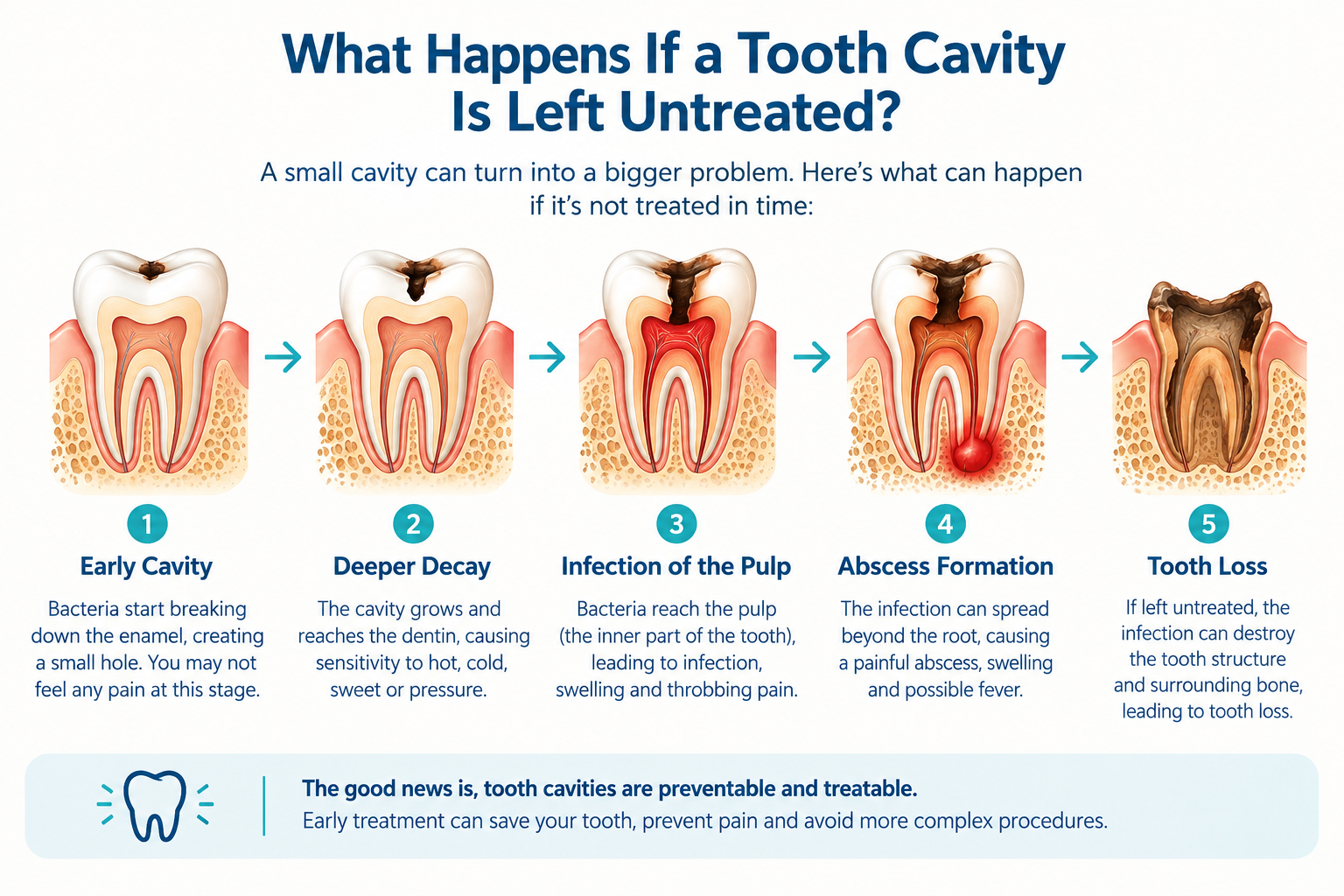
What Happens If a Tooth Cavity Is Left Untreated?
What Is a Tooth Cavity?
A cavity is generally an outcome of tooth decay. It is a discontinuity of the tooth/or a saucer shaped defect that forms in a tooth’s enamel often caused by oral bacteria that feeds on the carbohydrates and sugars present in the foods that one eats. Plaque, sticky film formed by bacteria on teeth surfaces, causes cavities when it stays on a tooth surface where food and water cannot easily flush it out. Sugar or any other carbohydrate that one consumes reacts with the bacteria in the mouth to create acids that attack the teeth. These acids erode the enamel which is the hard outer layer of the tooth. In the meantime, the person cannot feel the cavity or can feel only a tiny discomfort when the decay is in its earliest stages.
What Happens If Cavities Are Not Treated?
A cavity or multiple cavities that are not treated will continue to grow. Depending on the severity and the position, it may lead to extreme tooth sensitivity and toothaches, nerve inflammation, infection, abscess, and in extreme cases, tooth loss. It is essential to understand that although cavities do not always develop in the same manner, they generally progress and do not heal on their own. The information above would help one understand the importance of treating cavities.
Stages of an Untreated Dental Cavity
Stage 1 – Enamel Damage
The cavities generally begin as a tiny discoloration on the enamel. At this point, there may not be any pain because enamel does not have nerve endings. A dentist can sometimes observe the early stages of cavity development during an oral examination. One can live with enamel decay for some period, with no discomfort. Nevertheless, a regular dental examination is vital since there is a possibility that the defect would have progressed into an extensive cavity.
Stage 2 – Spread of Decay to Dentin
The decay spreads to the underlying layer of the tooth, which is known as dentin if it is not treated promptly. Decay progresses faster in dentin, which makes it more challenging to treat. When the decay reaches the dentin, the person may start experiencing toothaches or extreme sensitivity to hot or cold food or drinks. At this point, the dentist will most likely treat the cavity. A filling, for instance, can be used to remove and clean the decay and reshape the tooth to prevent the cavity from becoming worse.
Stage 3 – Tooth Decay Has Reached the Pulp
At this point, the decay has moved to the deepest layer of the tooth and is close to the pulp chamber. A person may feel a dull ache around the cavity as the nerve begins to die. There is also a higher chance that the person will feel pain when chewing or biting due to the pressure around the tooth. If the cavity reaches the pulp and inflames it, the dentist may recommend a root canal procedure. The damaged nerve is removed in this procedure, and the empty space is filled with an inert filling material.
Stage 4 – Dental Infection or Abscess
The dental infection or abscess occurs when the infection from the pulp tissue spreads beyond the root and the surrounding bone. The abscess can cause a dull ache around the infected root and the person may have a fever and feel ill. At this point, if not treated it may progress to a cyst which may need a surgical intervention. However, when a cavity leads to an abscess, it requires the attention of a dental professional to prevent it from becoming worse.
Stage 5 – Tooth Damage or Tooth Loss
The cavity may spread and destroy the tooth structure and the surrounding bone, necessitating its removal if it has reached this stage. Depending on the situation, the dentist may advise a root canal and a crown to restore the tooth or a dental implant to replace the lost tooth. The dentist may also suggest replacing a missing tooth with a bridge.
Common Complications of an Untreated Cavity
As the cavity progresses, it may cause several other problems in addition to causing toothache or discomfort. The following are the common complications that an untreated decay or a cavity may cause:
- Increased sensitivity of the teeth
- Toothache
- Deep cavity
- Nerve inflammation
- Infection
- Abscess
- Swelling in the gums
- Pain when chewing
- Eating is painful on one side
- Weakened tooth structure
- Tooth loss
- Requirement for more extensive procedures to treat the tooth loss
Can a Cavity Spread?
A cavity does not spread from one tooth to the other,but can be present between two teeth and continue to progress if untreated. However, if the cavity in one of the teeth is not treated, it will continue to grow and destroy the tooth. In addition, the bacterial infection in the mouth can cause problems in other teeth. For example, the bacteria in the cavities can spread to other teeth and cause additional cavities to form. Therefore, although a cavity does not spread from one tooth to the other, a person is still at greater risk of having more cavities and should take measures to prevent them.
Signs That Your Cavity May Be Getting Worse
The following are the indications that a cavity is getting worse:
- The teeth have become more sensitive than before
- There is a dull or constant toothache
- A person is experiencing pain when biting or chewing
- The person feels pain or a tingling sensation when they eat or drink something cold
- The person feels discomfort or pain after eating or drinking something sweet
- A person can see a hole or a discolored spot on the tooth surface
- The food keeps sticking in the affectedarea of the mouth
- The person can constantly feel a bad or sour taste in their mouth
- The gums around the affected area are swollen
- There is a swelling on the face
- Toothache is accompanied by a fever
What Causes Tooth Cavities?
The following are the leading causes of cavities:
Poor Oral Hygiene
When a person fails to brush and floss regularly, plaque accumulates, feeding the bacteria in the mouth.
Consuming Too Much Sugar
Every time one consumes carbohydrates,it acts as a source of nutrition for the bacteria in the mouth which in turn produces acid. Eating sugary snacks or drinks also increases the time that acids stay in the mouth. These acids cause dissolution of tooth structure and further form a cavity. Therefore, when one eats or drinks something sweet, the risk of developing a cavity increases.
Eating or Drinking Something Acidic
Acids in the food that one consumes, such as citrus fruits and aerated beverages, destroy the enamel of the teeth.
Having a Dry Mouth
The condition can be caused by several medications, and it may also be congenital. Having a dry mouth increases the chances of developing cavities because the saliva flow is reduced in the mouth which reduces the self cleansing action of saliva.
Snacking Often
Snacking continuously increases the rate at which bacteria in the mouth feed and multiply. Ideally, one should wait at least three or four hours after eating to give the teeth enough time to repair themselves before the acids start working again.
Having Few or No Dental Checkups
Having a cavity means that the person did not maintain good oral hygiene. However, not visiting the dentist often also contributes to the development of cavities because it allows cavities to advance without detection and treatment.
How Is a Tooth Cavity Diagnosed?
A cavity is diagnosed through a physical examination by a dentist. The dentist conducts a series of tests which includes taking detailed history, inspection of the teeth and by taking radiographs. A physical examination of the mouth and teeth includes thorough examination of the existing fillings and checking for the sensitivity of the teeth to hot and cold temperatures. The dentist also examines the gums and surrounding soft tissues for any changes. An x-ray is recommended when they suspect that there is a cavity that they cannot diagnose with the naked eye. A regular dental examination is an excellent way to detect and treat cavities early.
Tooth Decay Treatment Options
Depending on the severity of the cavity, the dentist will recommend a suitable treatment plan. The following are the most common treatments for cavities:
Fluoride and Preventive Dental Care
When the cavity is in its early stages and has progressed to the enamel layer, the dentist can often treat it with fluoride. In this case, the dentist will recommend that the person continues to care for their teeth by brushing them and flossing regularly.Pit and fissure sealants are recommended for narrow and deep discolored pit and fissures on the teeth to prevent their progression into big cavities.
Dental Fillings
Once the cavity has formed, the dentist will recommend removing the decayed portion of the teeth and filling the empty space with a mixture of materials to restore the functionality of the teeth. The dentist can recommend a filling to treat moderate cavities.
Root Canal Treatment
When the cavity is left untreated until it reaches the pulp or the center of the tooth where nerve and blood vessels are present, the dentist will recommend a root canal treatment. This procedure involves the removal of the pulp of the infected tooth and filling the empty space to prevent further infections.
Dental Crowns
In some cases, a dental crown may be necessary to restore a tooth that has been severely damaged by a cavity. The dentist can recommend a dental crown to cover or replace a large portion of the tooth that has been removed during filling procedure or during a root canal procedure.
Tooth Extraction
When a cavity is extremely severe, the dentist may recommend removing the affected tooth. They will then suggest restoring the extracted tooth with a dental implant or a bridge.
Tooth Replacement
The dentist can recommend several options for replacing a missing tooth, such as a bridge or an implant. These options can be used to restore a tooth that has been extracted for a cavity.
Treatment of Tooth Decay @ JP Nagar
The treatment that a dentist will recommend for a cavity depends on its severity. As such, it is essential to consult with the dentist to identify the most appropriate course of treatment since they can detect a cavity during an oral examination.
How Can You Prevent Cavities From Getting Worse?
The following are some of the ways that one can follow to prevent cavities from getting worse:
- Brushing teeth twice a day
- Using a fluoride toothpaste to prevent cavities and protect the teeth from bacteria
- Cleaning between teeth at least once a day to remove food particles and plaque
- Limit the amount of snacking
- Drinking plenty of water to prevent the accumulation of food particles in the teeth
- Avoid consumption of tobacco products
- Practicing good oral hygiene in general
- Visiting the dentist for regular oral checkups
- Getting professional cleanings to remove any plaque that is not accessible for the patient
- Treating cavities early enough to prevent them from becoming worse
- Following the dentist’s recommendations for preventing cavities
Can an Untreated Cavity Heal on Its Own?
The answer to this question is that it is not possible for an untreated cavity to heal on its own. However, it requires that one starts taking very good care of their teeth to prevent further progression. If the person detects a cavity and takes measures to prevent it from getting worse, there is a chance that it will heal. A cavity will not be able to heal on its own once it has occurred, and one will have to consult a dentist to treat it.
When Should You Visit a Dentist for a Cavity?
One should visit a dentist for a cavity when they experience any of the symptoms that a cavity can cause. The following are some of the symptoms that indicate that one needs to visit a dentist:
- Spot or hole in the tooth
- Toothache
- Extreme sensitivity
- Pain while chewing or biting
- The person has a tooth that is broken, chipped, or worn
- The person experiences discomfort when they chew
- The gums around the affected area are swollen
- Changes in the way that the person eats
- A bad or unusual taste in the mouth
- Facial or mouth swelling
- Fever
A dentist can help treat cavities and other oral problems. They can recommend the appropriate treatment to treat the cavity depending on its severity. Nevertheless, it is essential to address the issue as early as possible to avoid the need for extensive treatments.
Why Early Treatment Is Better Than Waiting
Early treatment is better for cavities because it can prevent the cavities from becoming worse. Early treatment can also help one avoid more uncomfortable procedures later and help them save money in the long run because one will not have to spend a lot of money on extensive treatments. It also reduces the possibility of one experiencing discomfort and the inability to eat certain foods. Lastly, early treatment can help prevent the loss of a tooth.
CONCLUSION
A cavity is a small hole in a tooth that generally occurs when tooth decay, which is caused by oral bacteria, that destroys the enamel. Cavities do not generally heal on their own; instead, they continue to grow until they destroy the tooth completely or reach the pulp chamber containing nerves, causing infections. Although cavities do not always occur in the same manner, they usually progress, and there are several treatments for them depending on their severity. One can identify the presence of a cavity because of the discomfort that it can cause or when the dentist identifies it during a dental examination. Nevertheless, one should consult a dentist if they suspect that they have a cavity because the earlier it is treated, the lesser the impact it will have on one’s life.
Frequently Asked Questions:
If left untreated, a cavity typically continues to progress deeper into the tooth, moving from the enamel into the dentin and eventually the pulp. This progression can lead to increasing sensitivity, toothache, pulp inflammation, infection, and in more advanced cases, an abscess or damage significant enough to threaten the tooth. The exact timeline and severity varies, but decay generally does not resolve on its own once a cavity has formed.
A cavity itself doesn't transfer directly from one tooth to another, like the way an infection spreads from person to person. However, the bacteria, plaque buildup, and dietary habits responsible for one cavity can also affect other teeth in your mouth. This is why a single cavity is often a good reason to review your overall oral hygiene routine rather than treating it as an isolated concern.
Signs that decay may be progressing include increasing sensitivity to hot, cold, or sweet foods, persistent toothache, pain when biting or chewing, a visible hole or dark spot, food getting trapped in the same area, bad breath, or gum swelling near the tooth. Facial swelling or fever alongside these symptoms suggests a more urgent evaluation is needed.
Yes, when decay progresses far enough to reach the dental pulp, bacteria can multiply within the tooth and potentially spread into surrounding tissue, sometimes resulting in an infection or abscess. Not every untreated cavity leads to infection, but the risk increases as the cavity progresses deeper. Also longer the decay is left unaddressed, making prompt evaluation important.
Very early enamel changes, before an actual hole has formed, may sometimes be supported with fluoride, better oral hygiene, and dietary adjustments. However, once a true cavity, meaning an actual structural hole, has developed, it generally cannot heal on its own and needs professional dental treatment rather than home remedies.
Root canal treatment is typically considered when decay has reached the dental pulp and caused significant inflammation or infection of the nerve and blood vessels inside the tooth. This often presents as noticeable toothache, heightened sensitivity, or spontaneous pain. A dentist can confirm whether root canal treatment is needed after an examination and, if necessary, by taking X-rays.
Deep tooth decay can lead to complications such as persistent toothache, pulp inflammation, dental infection, abscess formation, gum swelling, difficulty chewing, and weakening or fracture of the tooth. In advanced cases, it may also result in tooth loss. The likelihood of these complications depends on factors like the depth of the decay, location, and how promptly it's addressed.
Brushing twice daily with fluoride toothpaste, cleaning between teeth, limiting frequent sugary or acidic foods, staying hydrated, and attending regular dental checkups all help manage cavity risks. If a cavity is already present, seeking timely treatment at JP Nagar rather than waiting is the most reliable way to prevent it from progressing further.